
Ignacio García González: «Trees are living black boxes, recording a forest’s environmental history»
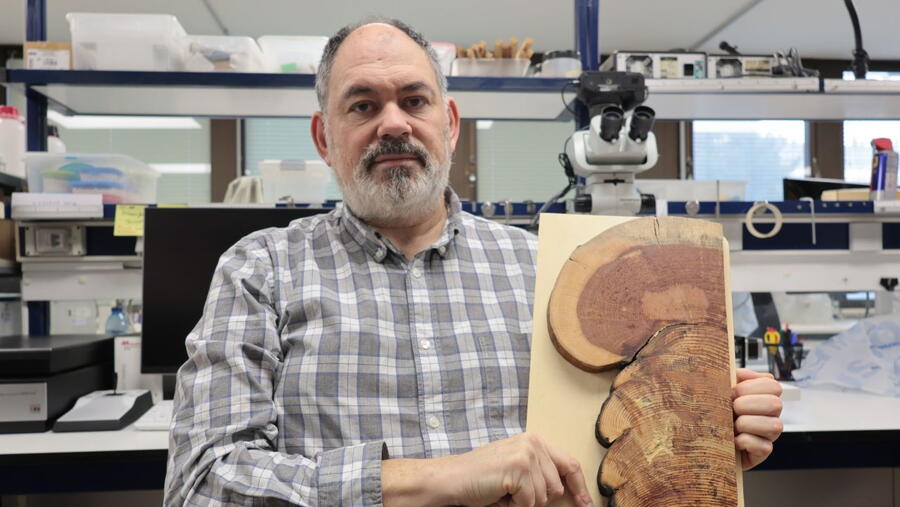
The environmental history of a forest can be read in the wood of its trees. This is the premise that runs through Ignacio García González's research career and gives meaning to an interview in which time, climate, and tree growth dialogue through the oak trees' rings in northwestern Iberia.
Ignacio García González is a professor at the Higher Polytechnic School of Engineering, Department of Botany, University of Santiago de Compostela, and affiliated with IBADER. Over more than two decades, he has researched dendrochronology and quantitative wood anatomy.
From his early interest in botany to his coordination of projects, his work clarified how trees record, at the cellular level, the effects of climate and environmental events.
In this conversation, he reflects on the response of oak trees to climate change, the value of basic research in anticipating future scenarios, and the role of the university in the conservation and sustainable management of forest ecosystems.
A scientific perspective that combines the past, present, and future to decipher how forests work and what decisions we must make to protect them.
-Your career at USC began more than two decades ago. How do you remember your first steps in botany, and what led you to specialize in the study of radial tree growth, especially oak trees?
-Since I began my studies in biology, I have always had a special interest in botany, practically in every field of it. When I finished my degree and decided to pursue a doctoral thesis, my main interest was that it be related to plants, though I did not want to limit myself to studying only plants; rather, I wanted to conduct multidisciplinary research. What attracted me most was the relationship between plants and environmental factors, especially climatic ones.
Among the many techniques that could be used for this purpose, one of the first that came to mind was dendrochronology, the analysis of tree rings, which allows us to look into the past and learn about a tree's history throughout its life. At first, I thought it would be just another technique to apply in my doctoral thesis, but as I delved deeper, there was no doubt that it was more than enough to complete a doctorate, especially at a time when dendrochronologists in Spain could be counted on the fingers of one hand. And dendrochronology was the ideal tool for understanding the main factors influencing oak tree growth, the dominant species in Galicia's forests. It was also a time when dendrochronology was making significant advances, especially with the introduction of other techniques such as anatomical analysis and isotopic studies, which were beginning to be applied, albeit not systematically.
In botany, I had always been quite interested in plant anatomy, even before I began applying it to growth rings. Thus, towards the end of my doctoral thesis, I extended my research in dendrochronology to this field after observing that the conducting cells (vessels) varied significantly from one ring to another, and that this variation in size and number could be quantified and provide environmental information that, in many cases, was more valuable than that provided by the width of the rings. I therefore focused my subsequent research on the anatomical characteristics of growth rings.
-Dendroecology and wood anatomy are two recurring themes in your research career. How would you explain, in simple terms, what information a growth ring can reveal about the environmental history of a forest?
-A definition I really like is that a tree behaves like a “black box,” collecting all the events that occur throughout its life. When a growth ring forms, the cells that compose it are of different types, and their characteristics can vary. It is the environmental conditions at the time of ring formation, or their predisposition a few months earlier, that determine what those cells will be like and, therefore, the final appearance and size of the ring. As they form from the center outwards, each growing season adds a new ring, but the previous ones remain unchanged. The “reading” or interpretation of these rings through dendrochronology allows us to reconstruct past conditions. In addition, trees that grow in the same environment or under the same conditions have similar patterns, allowing them to be dated relative to one another, fit together like a puzzle, and construct long sequences that overlap. This overlap is the basis of dendrochronology and is called synchronization.
From these sequences, past processes can be identified. They can be compared with climate records to identify which variables control growth and the effects of extreme weather events (e.g., late frosts, droughts, storms). Forest fires can leave scars on the rings, insect pests or pruning can cause reductions in growth... all events that can be dated by dendrochronology. When a tree is cut down or dies, nearby individuals are freed from competition and begin to grow faster. Even global processes that affect much of the planet, such as large volcanic eruptions, also leave their mark in the form of frost rings or other signs. All these characteristics make it possible to reconstruct a history of events in forests, and this information is even greater if the anatomy of the rings or even the chemical composition of their cells is analyzed.
This information from these chronologies can be combined across increasingly larger spatial and temporal sequences, spanning continents and millennia. For these reasons, dendrochronology is the main tool for reconstructing past climate in climate change studies and for historical processes, such as changes in civilizations, through the dating of their wooden constructions. It is possible to date multiple objects, such as buildings, shipwrecks, works of art, musical instruments, etc., based solely on their wood.
-An important part of your work focuses on understanding the response of oak trees to future climate change scenarios. What signals are these trees currently offering in the Iberian northwest, and what implications could they have for forest management?
-Oak trees are the most important species in the natural forests of northwestern Iberia, which also constitutes their southwestern distribution limit in Europe. Unlike most of the peninsula, where the climate is Mediterranean, and oak trees are replaced by other species because they cannot withstand prolonged drought, two oak species dominate in Galicia. The most common, which we call carballo (Quercus robur), is more widespread in Europe, while the rebolo (Q. pyrenaica) has a more Mediterranean tendency, i.e., it is more resistant to drought but has a shorter growing season because it opens its buds very late to avoid late frosts.
With these ideas in mind, the working hypotheses of our first projects focused on the idea that the rebolo, which is more drought-resistant, could replace the carballo as stress from climate change increased. However, the results we obtained were much more complex and did not limit themselves to one species being favored and another benefiting. We now have a much better understanding of how these species grow. They have a very peculiar type of anatomy, called a “porous ring”; they are trees that form very large vessels at the beginning of the season, which are very efficient at conducting most of the water.
But these vessels, which are essential to their survival, are formed from last year's reserves. From our analyses of wood formation, we know that both species stop growing relatively early in the summer, and it seems that if conditions are unfavorable, for example, a severe drought, their priority is not to form more wood but to secure the necessary reserves for the following season. And this is where climate change plays a very important role, because if drought increases during the summer, trees will not only grow less, but they will also accumulate fewer reserves, which must sustain not only initial growth the following year but also the tree's respiration during the winter, when it lacks leaves that can assimilate. The anatomical results we have show that conditions during the winter, especially if it is warm and rainy, are closely related to the appearance of the vessels the following spring, but we still do not understand the mechanism involved.
However, within this strategy common to both species, there are also certain differences. Thus, the carballo seems more sensitive to adverse conditions such as drought, but it also grows more when conditions are favorable; that is, it takes more risks to achieve greater benefits, while the rebolo seems more conservative in this regard.
-In recent years, you have incorporated xylogenesis as one of your main lines of work. What does this technique contribute to the study of tree growth, and to what extent has it contributed to the projects your research group is working on?
-My research career began with what I call “classical dendrochronology,” based on the width of growth rings. From the initial results, we found that trees in this region of Europe showed a strong common signal, indicating that they responded very well to environmental factors. This is usually the first step in understanding how climate influences growth.
However, when the same series was compared with the climate series, we did not obtain a good response, perhaps due to the absence of one or a few limiting factors, causing the control to differ from one year to another (sometimes a late frost, other times a drought, conditions that continued throughout the season, etc.).
For this reason, we completed the analysis of climatic responses by measuring vessel sizes throughout the rings using image analysis. In this case, there was a strong relationship with climate, much stronger than in ring width, providing complementary information not recorded in the width.
From the end of my doctoral thesis until approximately 2010, I focused mainly on the methodological development of this emerging discipline, Quantitative Wood Anatomy, and specifically on species such as oak that exhibit a porous ring structure.
However, this work raised a new question. The association between vessel size and climate was very strong, but its interpretation required understanding the mechanism underlying this response.
For example, a fairly consistent response was that, in many areas, mild winters were associated with smaller spring vessels, which was difficult to interpret. It therefore became necessary to know precisely when each element of the wood is formed, how long it takes for the vessels to reach their size or to conduct water, and the relationship of these processes to other growth processes, such as leaf formation and maturation. These questions led to xylogenesis, a discipline that began to gain popularity in the second half of the 2000s, well suited to answering them and to interpreting the results of dendrochronology and quantitative anatomy in terms of cause and effect.
Therefore, I believe that, among the techniques applied so far, although most of my projects have had xylogenesis as one of their fundamental pillars, my greatest contribution lies in quantitative wood anatomy. Since it was the questions raised by quantitative anatomy that led me to begin working on xylogenesis, I consider quantitative anatomy and dendrochronology to be my main disciplines, and xylogenesis to be a consequence arising from the need to complete these fields. In any case, I always approach my research projects from three main interrelated and inseparable perspectives: dendrochronology, quantitative anatomy, and xylogenesis, progressively expanded with other necessary techniques, as it is essential to understand how the environment affects other processes in the tree that ultimately determine wood formation.

-You have served as the Principal Investigator for several national and regional projects, including THERMOXYLO and ROCLIGAL. What scientific challenges did each one face, and what results would you highlight from each of them?
-During the period 2011-2014, I developed my first research projects as Principal Investigator, one at the national level (XIRONO) and another at the regional level (ROCLIGAL), both with similar themes and complementary content.
Until then, I had focused all my research on “classical dendrochronology” (growth-ring width) and on the development of quantitative wood anatomy (applying dendrochronological techniques to anatomical parameters for each ring). At the time of applying for these projects, we had developed several dozen chronologies in the northwest of the Peninsula, some with very good signals, but we could not find clear relationships with climatic factors, so it was necessary to better understand both the anatomical responses and the processes of wood formation. Therefore, these two projects aimed to expand the chronology network using quantitative anatomy (much more labor-intensive than simply measuring rings) and to initiate xylogenesis studies. XIRONO compared responses and monitored wood formation of the two dominant oak species in Galicia, coexisting along a Mediterranean gradient, over two years, and was a very intensive study on a temporal scale.
ROCLIGAL conducted similar analyses across three river basins, with altitudinal variation as the primary gradient. In this case, greater attention was paid to the spatial scale than to the temporal scale, with monitoring focused more on the population than on individuals. These projects gave rise to four doctoral theses (two mainly on xylogenesis and two on quantitative anatomy) and more than 15 high-impact scientific publications.
THERMOXYLO is a more recent project that ended just over a year ago, and we are still working on publications based on the results. The initial approach was similar to the previous ones, but in this case, the study focused specifically on the oak that dominates the thermophilic forests of Galicia, i.e., forests subject to higher temperatures and therefore with a more Mediterranean tendency. These are also the natural oak forests with the greatest anthropogenic pressure and, due to their characteristics, the most sensitive to climate change.
Our idea was to see how wood formation was affected by stress at two times of the season: during the summer, with high temperatures and drought, and during the winter, when mild temperatures could influence reserve balances. We compared three different areas: the Cantabrian coast, with mild, humid summers and mild, rainy winters; the Atlantic coast, with warmer, drier summers and mild, very rainy winters; and the inland area, mainly in Ourense, with very hot, dry summers but more continental winters and lower temperatures.
-You also coordinated the Marie Curie ForSEAdiscovery international network, which linked ecology and history through dendrochronology. What was it like to work on a project of this scale, and how did it contribute to your research vision?
-It is true that Marie Curie ITN networks are large-scale projects, as they involve not only research but also, and more importantly, an associated training program, which, in the case of ForSEAdiscovery, included the completion of more than 10 doctoral theses and the training of three postdoctoral researchers. My role in this network was Scientific Coordinator, but the overall coordination of the project was handled by CSIC researcher Ana Crespo Solana.
ForSEAdiscovery was undoubtedly the most multidisciplinary project I have worked on in my entire career, as it involved people from a wide range of fields. The central theme of the network was the trade in wood for shipbuilding in the Iberian Empires during the Age of Discovery (15th-17th centuries), and many different techniques were used to this end. While historians focused on archival research, a team of underwater archaeologists studied submerged shipwreck sites and obtained wood samples that we could then use. The third work package, of which I was a part, was dedicated to applying various techniques to determine the origin of the wood, using living trees and testing them on wood from the shipwrecks. In the case of dendrochronology, we obtained chronologies for the Cantabrian Mountains, the Central System, and Andalusia, both from living trees and from buildings, resulting in series spanning more than 7-8 centuries.
But aside from the scientific results obtained, the experience of working with people from such different fields was very rewarding.
-Since 2019, you have been coordinating the Biodiversity and Applied Botany unit, recognized as a Competitive Reference Group. What is the group currently focusing on, and what lines of research do you consider most promising?
-The Biodiversity and Applied Botany (BIOAPPLIC) group initially emerged as a union of several researchers from the Department of Botany pursuing diverse lines of research, though all focused on botany. Our goal was to achieve synergies that would allow us to develop a research unit with common interests. When the group was created, we had hardly any collaborative work, except for a few very specific projects, but we managed to set some common goals and tried to collaborate more as a group.
Since its creation in 2015, we have achieved regional recognition as a Competitive Reference Group, which we have maintained to date after three consecutive calls for applications. By its nature, BIOAPLIC is a bi-campus research group; for this presentation, I will focus mainly on the Terra Campus. Thus, in Santiago, we develop lines of research in Aerobiology and Phenology, Phycology (both freshwater and marine algae), and Fire Ecology. At the Terra Campus, we have diverse lines of research in Fungal Biodiversity and Plant Pathology, Geomatic Methods for Biodiversity Analysis (using remote sensing images), and the two lines focused on Wood Biology in which I participate: Xylogenesis (study of wood formation throughout the growing season) and Dendrochronology and Quantitative Anatomy (focused on the analysis of tree growth rings).
However, I would not highlight any of the lines as more promising than others. So far, the group has been able to obtain significant funding for all of them, sometimes fluctuating from year to year; some, due to their nature, such as basic research, receive more public funding, while others are more easily able to attract private funding due to their immediate applicability. But the fact is that today most research projects require a multidisciplinary approach and not the participation of a single line. In this regard, at Campus Terra, we have managed to integrate the different lines of research, which has resulted, for example, in the national THERMOXYLO project, an agreement on the mortality of alder groves, and new project applications that are currently underway.
-With more than 65 indexed articles, a high number of citations, and extensive work as a reviewer and editor, how do you assess the role of scientific publication in the construction of knowledge and the international projection of Campus Terra?
-Scientific publication is the product that gives research the greatest visibility, and it is necessary for that knowledge to reach other working groups and thus progress. With regard to the work of reviewers and editors, especially the former, I believe it is essential. It is often seen as a thankless task, as it seems like an “extra” burden with no remuneration for those who do it, yet it is necessary for the system to continue functioning. Given that scientific publications use “peer review,” that is, prior evaluation by other experts in the same field, I believe it would be fair for a researcher to provide at least a similar number of reviews for their publications. To my work in these fields, I would also add the review of scientific proposals, which I carried out for agencies in several countries (although this information is often not disclosed, as many of them are anonymous). This is also essential to the entire system continuing to function.
As for the international projection of Campus Terra's scientific publications, I believe we sometimes fail to realize that they are of a very high standard. One need only attend any event at which the Campus's different lines of research are presented, or take a look at the USC Research Portal, which displays publications and research projects, to realize the relevance of the Campus.
I also think it would be very important to increase outreach efforts to inform the general public about the main results and the importance of scientific research, as well as to support all activities aimed at schoolchildren to awaken their interest and vocation for science.
-In your teaching career, you have supervised numerous final degree projects, master's theses, and doctoral theses. What do you seek to convey to your students, and what aspects of teaching do you consider most essential for training new generations of botanists and researchers?
-Unfortunately, I have noticed a growing trend among students to show less interest in research and scientific work in general. I have noticed this especially in TFG and TFM projects, which I have supervised many times since I began teaching, but, if I remember correctly, only once in the last decade. In the case of doctoral theses, this is largely due to the resources available, which are often associated with contracts for researchers, but I do think there is less interest than when I finished my degree.
It is also true that the campus lacks adequate training in the basic sciences, where students are more likely to have a greater vocation for scientific fields such as botany. In any case, it is essential that students become aware of the importance of scientific research and how it is carried out. For me, it is very important that students, through teaching, learn how research is conducted and engage in classroom activities using scientific articles appropriate to their academic level. Often, students who conduct experimental work during their degree, especially in a bachelor's or master's thesis within a research group, discover a scientific vocation they had not previously expressed.
-Finally, what scientific questions would you like to answer in the coming years about Atlantic and Mediterranean forests, and what role do you think the university should play in the conservation and sustainable management of these ecosystems?
-So far, most of my research has focused on oak trees, and many scientific questions remain about these species. But I would like to extend my research to other species, better understand the environmental factors that control their growth, how they behaved in the past, and infer their future behavior in the face of possible environmental changes. In this regard, the technique I would most like to explore in depth is Quantitative Wood Anatomy, to gain a good understanding of the signals that can be recorded in wood at the cellular level and what triggers a particular response in trees.
I must admit that, in my case, I have a particular inclination towards basic research, towards understanding why plants respond in certain ways. And this research can only be done by public organizations with adequate funding, without the need to expect an immediate return. We must be aware that this generation of knowledge will always offer a return, but often one that is deferred. For example, at a given moment, we want to know how a species or a forest responds to a disturbance or a disease, or how it will behave in the face of climate change. Or there may already be a process causing ecosystem degradation, and we want to know how to intervene and what response we can expect.
But without this basic research, we lack the knowledge necessary to propose solutions, such as how a species functions, what environmental factors limit its growth, how it responds to various events, and what factors can benefit or harm it. This is the type of research with which I most identify.
Obviously, we cannot forget the application of this knowledge, and often no progress is made because the results of this basic research do not reach other researchers more oriented towards its immediate application. In addition, the results of both basic and applied research must be disseminated to those responsible for management and decision-making. I believe that closer collaboration between researchers and managers would be desirable, so that the latter could apply the research results and the former could understand the needs that must be addressed, thereby enabling us to tailor our research to those needs.