
Jacobo Álvarez Torres: «Reducing methane emissions requires measuring them under real operating conditions»
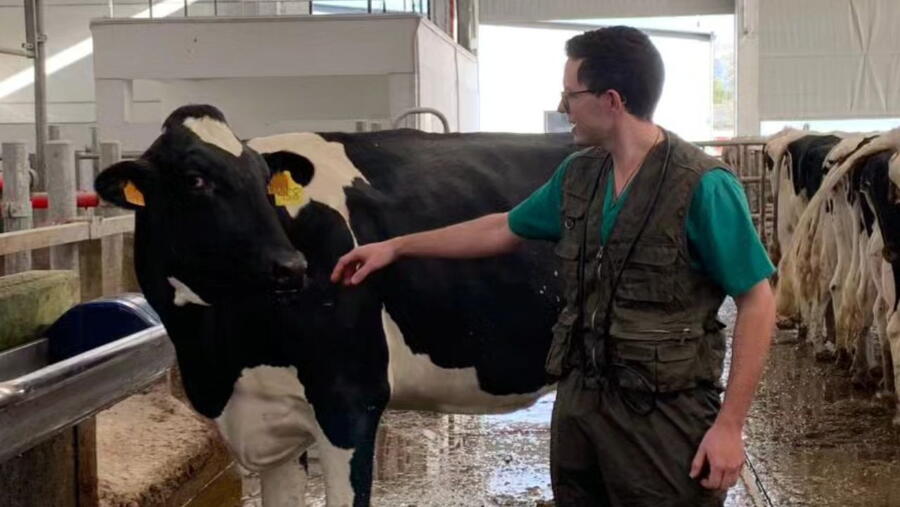
The work of Jacobo Álvarez Torres, a predoctoral researcher with the Reprogal (Reproduction and Obstetrics) Group at the Faculty of Veterinary Medicine on the Terra Campus, lies at the intersection between animal production, environmental sustainability, and dairy cattle reproduction, with a clear focus on the livestock sector.
For his doctoral thesis, he designs a device to measure individual methane emissions in dairy cows, aiming to mitigate cattle's climate impact.
The aim is to transfer the measurement of this gas from the experimental field to commercial farms, enabling a realistic assessment of how feed, additives, and management practices influence emissions.
At the same time, Álvarez Torres is working on key problems in bovine reproduction, such as repeat breeding syndrome, a condition with significant economic consequences for farms. As part of the Reprogal group, his research focuses on improving the diagnosis and understanding of factors such as subclinical endometritis and oviduct permeability to achieve greater reproductive efficiency.
Throughout the interview, the researcher also reflects on the importance of collaborative work, practical teaching in veterinary medicine, and scientific dissemination as tools for bringing science closer to society. Convinced that more efficient animals are also more sustainable, he advocates for livestock farming grounded in scientific knowledge, genetic selection, and the effective transfer of results to the productive sector.
-You are developing your doctoral thesis on mitigating the impact of dairy cattle on climate change. What is the main focus of your work, and what progress have you made so far?
-The main focus of my research is the design of a device for measuring methane at the individual level in dairy cows. We now have a prototype that is almost functional, and we are improving its placement and comfort for the animal.
-In recent years, you have contributed to several international scientific articles on cattle health and reproduction. What role does collaborative research play in your projects, and what have you learned from working with multidisciplinary teams?
-Collaboration with researchers from other fields or groups is essential to improve knowledge and advance it more quickly. Although cattle reproduction may be thought of as a very specific field, we do collaborate with other groups and individuals because, as we say, everything affects reproduction.
-Part of your work focuses on repeat oestrus syndrome in dairy cows. Why is this a significant problem, and what progress is being made to improve its diagnosis and treatment?
-In livestock farming in general, the aim is always for the animals to reproduce, either to have calves and fatten them up, or to produce milk and make use of it. The repeat estrus syndrome in cattle, especially dairy cattle, is a very important problem on farms because these are healthy animals with normal estrous cycles, yet for some reason, we are unable to get them pregnant, so there will be no gestation, subsequent calving, or lactation.
We are currently focusing our research on repeat oestrus syndrome in subclinical endometritis or oviductal permeability. In the research group, colleagues guide those of us just starting out so we can learn more about this pathology and the syndrome as a whole.
-You have also presented papers at conferences on methane emissions in dairy cattle. What lines of research do you think could be most effective in reducing these emissions without compromising production?
-Today, almost all research and methods to reduce emissions are being carried out at an experimental level and with a small number of cows, and there are so many factors that affect methane emissions that we cannot say that a method that reduces gas emissions at an experimental level can reduce them in the same way on commercial For this reason, we are designing this device: to see how different additives affect methane emissions on a commercial scale.
On the other hand, our group believes that the best way to reduce methane emissions in the long term and maintain stability is to select for the most efficient animals, without forgetting milk production, and to achieve optimal reproductive efficiency to increase profitability, which is closely linked to methane emissions. More efficient animals are more profitable and produce less gas.
-Teaching is part of a researcher's life. What experiences do you have in this field, and how do you try to convey to students the importance of research applied to the livestock sector?
Thanks to a grant from the Tomás Notario Vacas Foundation of Caja Rural, I am able to actively participate in the practical teaching of some subjects during the fourth and fifth years of veterinary school.
In my opinion, teaching should be a way to convey our passion for the subjects we teach, which are related to the research we conduct in our research groups.
A serious problem in science for many years was the lack of dissemination among the general population, and within the university, we have the opportunity to share our knowledge with students. This is something we must take advantage of.

-You have been involved in scientific outreach projects, such as 'Is it true that cows pollute?' and 'Doctor, what's wrong with my cow?' What does bringing science closer to society mean to you, and what response have you found in this type of initiative?
-Science that is not published, and not only in journals, cannot be called science. For me, it is essential to convey our knowledge to society and to let people know what we are working on in universities.
There is no point in publishing in the best journal in the world if that research does not go beyond that. Society responds surprisingly well to initiatives such as those developed by Agromar, the association of pre- and post-doctoral researchers at Campus Terra, often having to close registrations on the same day they open.
-From your experience, what do you think are the main challenges for veterinary medicine and animal production in achieving more sustainable and environmentally friendly systems?
-The core challenge is feeding a growing global population that is increasingly demanding animal products. Efficient food production in animal species and the maximization of by-product use to minimize waste are also vital.
-Finally, how do you envision your academic and research career in the coming years, and what goals would you like to achieve in the field of veterinary medicine and livestock research?
-I don't know what the future holds, but as long as it's linked to the cattle sector, it will be an achievement for me. I'm open to anything and not focused on a single goal.