
Joel Rodríguez Ruiz: «Today, it's inconceivable to make forestry decisions without continuous monitoring systems»
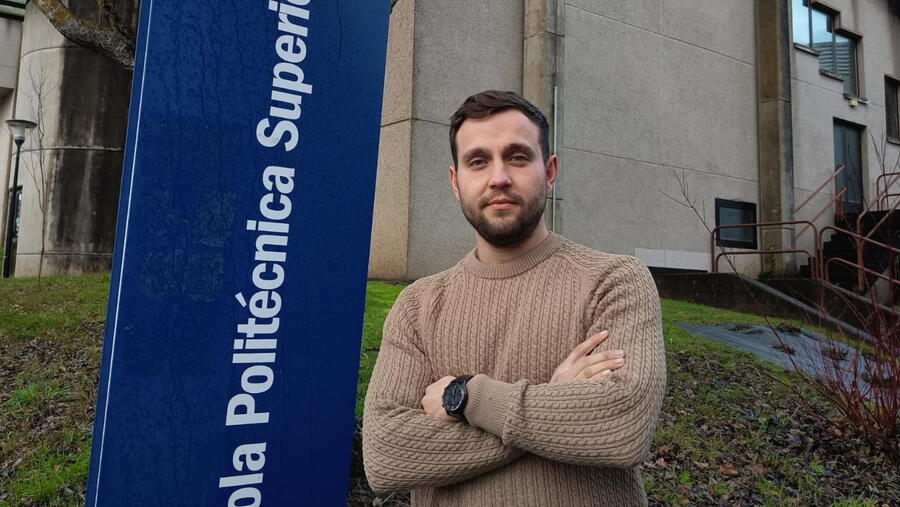
Joel Rodríguez Ruiz is an associate researcher at Campus Terra in the Projects and Planning Group (PROePLA), where he works in the field of forest monitoring and advanced data analysis applied to forest management.
After completing his doctoral thesis focused on the design and implementation of large-scale forest monitoring systems, his research work has become established in a key field for the future of the Galician forestry sector.
In this interview, Joel reflects on the technical and methodological challenges of continuous forest monitoring, the growing role of remote sensing in forest decision-making, and the innovations introduced by the Continuous Forest Inventory of Galicia, a strategic project to improve the planning and resilience of forest systems.
He also discusses the importance of knowledge transfer, his teaching experience during his pre-doctoral stage at the Terra Campus of the University of Santiago de Compostela, and the opportunities opening up for forestry research in areas such as decarbonisation and carbon markets.
-Your doctoral thesis focused on forest monitoring systems. What would you say were the main technical and methodological challenges of this work and what specific advances has it generated for this field of study?
-In large-scale forest monitoring systems, there are a large number of agents involved in their development and many needs to be met, so in most cases it is a complex task.
In this regard, my thesis sought to address challenges related to the management and design of this type of project, providing a methodological management proposal focused on the design and implementation of forest monitoring systems, as well as focusing on specific aspects of sampling design.
As an associate researcher in the project to develop the Continuous Forest Inventory of Galicia, what innovations or improvements are you introducing with respect to traditional forest inventory systems, and what impact do you expect them to have on Galician forest planning?
-First of all, I feel fortunate to be able to participate, from its inception, in a project such as the development of the Continuous Forest Inventory of Galicia, which seeks to respond to all the needs of a sector as important to Galicia as the forestry sector.
Meeting all the information needs is a major challenge due to the unique characteristics of the Galician sector. This requires the creation of an ad hoc system, seeking to obtain a continuous monitoring system that allows information to be obtained with short update periods, as well as a resilient system that can adapt to new changes in an efficient manner, seeking to respond to any needs that may arise in the future.
In this way, the Continuous Forest Inventory of Galicia seeks to meet the information needs demanded with a higher level of resolution than the systems currently in place.
-In your career at PROePLA, you have worked with modelling and analysis of forest data. What role do remote sensing tools and continuous monitoring currently play in forest decision-making?
-Fortunately, I was and am lucky enough to be part of a research group such as PROePLA, where I have been able to learn from leading experts on remote sensing tools and continuous forest monitoring. In my opinion, I think it is inconceivable at this point to make forestry decisions without taking these tools into account.
Many remote sensing products allow large-scale information to be obtained in short periods of time, which makes it possible to monitor forest systems on an almost continuous basis. If these types of tools were not incorporated, in many cases decisions would have to be made with outdated information, with the uncertainty that this entails.

-Between 2022 and this year, you had access to a pre-doctoral contract from Campus Terra that also allowed you to participate in teaching tasks. How has this stage influenced your approach to research and your vision of knowledge transfer?
-During the development of my thesis, I had the privilege of having a pre-doctoral contract from Campus Terra that opened the doors to university teaching, which allowed me to see it from the teacher's point of view and not just from the student's, which was my perspective until then.
I think that all pre-doctoral students should go through this experience, as research is not only about learning yourself, but also about teaching your progress, and I believe that teaching allows you to improve your communication and dissemination skills.
In this sense, I believe that the true success of research lies in its effective transfer, and therefore we must not forget that researchers, especially those of us who receive public funding, have a duty to transfer our knowledge and advances to the rest of society.
-Continuous monitoring of forests is key in the face of challenges such as climate change and fire risks. From your research experience, what do you consider to be the priorities today for improving the resilience and sustainability of Galician forest systems?
-The Galician forest system has a number of unique characteristics, such as the large number of very small forest plots, resulting in a wide variety of forest models.
This is exacerbated by the lack of management of many of the forest areas, caused in many cases by ignorance or the lack of an alternative that meets the owner's needs.
To a large extent, all this makes it difficult to establish resilient and sustainable strategies, and in my opinion, I think that improving these two aspects involves promoting active and joint management based on different forest models that are attractive to owners.
-Your line of work combines applied research and the development of management support systems. To what extent do you think Galicia is prepared to systematically incorporate advanced monitoring technologies, and what obstacles remain to be overcome?
-Galicia is a forestry powerhouse at the national and even European level, where the level of training and specialisation of those involved in the Galician forestry sector is high. Therefore, I believe that the application of advanced technologies is possible, although more specialised training would be necessary to facilitate their effective incorporation.
In addition, perhaps more work needs to be done with some of the owners who are not so deeply rooted in rural areas and are therefore unaware of the potential they have.
-Thinking about your professional future, what areas of forestry research would you like to continue exploring and what kind of projects do you see yourself contributing to in the coming years?
-I would like to continue working in forest monitoring, as I believe there is still a long way to go, and there are opportunities opening up with constant methodological advances and the emergence of new information needs.
An example of this is the needs related to carbon purchasing and decarbonisation projects to tackle climate change. Forests play a very important role in this area, and therefore, perhaps part of my future efforts will focus on this topic.